
The Impact of Wartime Sexual Violence Against Women and Girls in Tigray
Introduction
The war in Tigray has had profound and lasting consequences for women and girls, including conflict-related sexual violence (CRSV) and gender-based violence (GBV). Survivors continue to face physical injuries, psychological trauma, social stigma, economic hardship, and barriers to accessing justice and essential services.
As part of its 2025 annual operational and advocacy plan, the Tigray Mothers Relief and Rehabilitation Association (TMRRA) undertook an ethical, survivor-centered assessment to understand the experiences, needs, and socio-economic conditions of women affected by conflict-related sexual violence in Tigray.
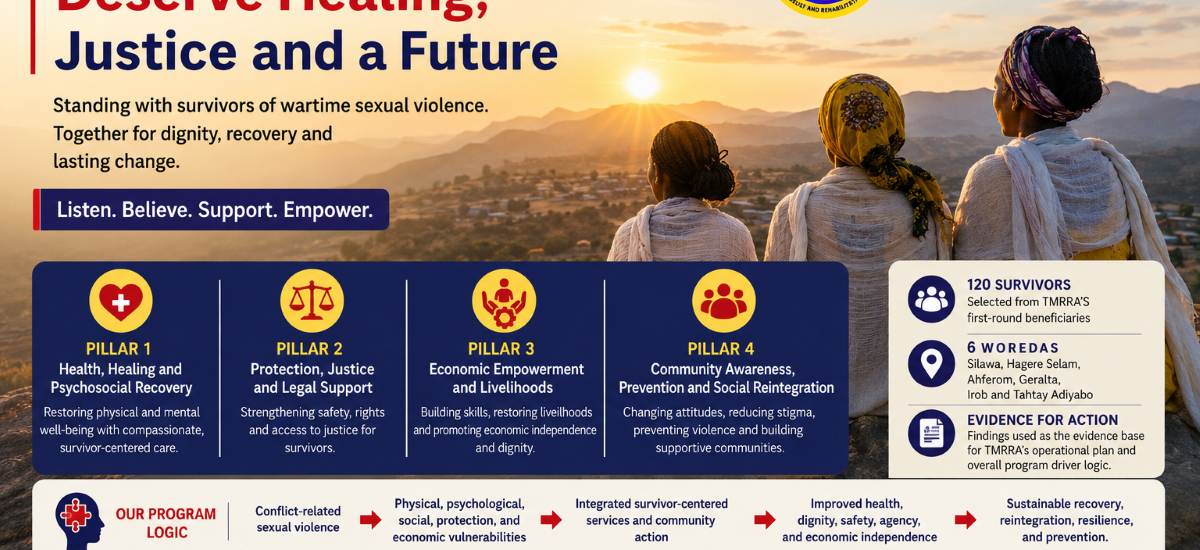
Importantly, this assessment was initiated by TMRRA itself as part of its organizational learning, planning, and program development process. TMRRA selected 120 survivor cases from among its first-round beneficiaries, drawn from six woredas across Tigray:
- Silawa
- Hagere Selam
- Ahferom
- Geralta
- Irob
- Tahtay Adiyabo
These 120 survivors formed the core group through which TMRRA sought to better understand the realities facing women affected by wartime sexual violence and the types of support required for meaningful recovery.
The assessment was therefore not designed as an isolated research exercise. Rather, it was developed as a practical organizational evidence base to guide TMRRA’s operational planning, program priorities, resource mobilization, advocacy, and survivor-support interventions.
The findings have informed TMRRA’s broader program driver logic: understanding survivors’ lived realities and vulnerabilities, identifying the barriers preventing recovery, and translating that evidence into integrated interventions addressing health, psychosocial well-being, protection, justice, livelihood recovery, and economic empowerment.
In this sense, the assessment represents an important part of TMRRA’s commitment to evidence-based, survivor-centered, and locally led programming.
From evidence to action: TMRRA’s approach is grounded in a simple principle: listen to survivors, understand their realities, use the evidence to design appropriate responses, and continuously adapt programs according to their needs.
1. Purpose and Institutional Significance of the Assessment
The assessment was undertaken by TMRRA to strengthen its understanding of the circumstances of survivors it was already supporting and to ensure that organizational interventions were based on the realities experienced by affected women.
The 120 selected cases represented TMRRA’s first-round beneficiaries from the six target woredas. Their experiences provided important information about the multiple and interconnected consequences of conflict-related sexual violence.
The assessment sought to understand:
- The timing and nature of reported sexual violence
- The physical injuries and health consequences experienced by survivors
- Survivors’ age and marital status
- The socio-economic consequences of the conflict and sexual violence
- The extent of survivors’ economic vulnerability
- The broader needs and barriers affecting recovery
- The types of interventions required to support sustainable recovery and reintegration
The findings were subsequently used as an important reference point for TMRRA’s organizational operational planning and program development.
Rather than separating assessment, planning, implementation, and learning into disconnected processes, TMRRA’s approach links them together:
Survivor experiences → Evidence generation → Needs identification → Program design → Operational planning → Implementation → Monitoring and learning → Program adaptation
This evidence-to-action cycle forms part of the logic driving TMRRA’s overall program approach.
2. Geographic Scope and First-Round Beneficiaries
The assessment covered survivors from six woredas representing different areas of Tigray:
|
No. |
Woreda |
|
1 |
Silawa |
|
2 |
Hagere Selam |
|
3 |
Ahferom |
|
4 |
Geralta |
|
5 |
Irob |
|
6 |
Tahtay Adiyabo |
A total of 120 survivor cases were selected from TMRRA’s first round of beneficiaries across these six woredas.
The geographic spread was important because survivors’ circumstances, access to services, livelihood opportunities, displacement experiences, and social conditions can differ considerably across communities.
By working directly with survivors across these locations, TMRRA was able to build a more grounded understanding of the challenges affecting its target population and use that knowledge to shape its organizational response.
3. Ethical Standards and Methodology
TMRRA recognizes that research and documentation involving survivors of sexual violence require the highest standards of ethics, confidentiality, safety, and sensitivity.
The assessment was conducted with particular attention to survivor dignity and informed participation. Key safeguards included:
- Informed consent from participants before data collection
- Confidentiality and anonymity to protect survivors from further harm or stigma
- Interviews conducted by trained female professionals
- Attention to the emotional and psychological well-being of participants
- Psychological first aid and referrals where immediate support or additional services were required
TMRRA’s approach was guided by the principle of do no harm. Survivors were treated not merely as sources of information, but as rights holders whose safety, dignity, choices, and well-being must remain at the center of all interventions.
The assessment also reflects TMRRA’s commitment to locally generated evidence. Rather than relying exclusively on external assessments or generalized statistics, TMRRA sought to understand the realities of women whom the organization was directly supporting.
4. Key Findings
4.1 Timeline of Reported Sexual Violence
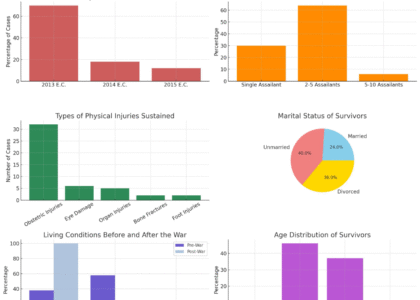
The assessment indicates that the majority of reported rape cases occurred during the most intense period of the conflict:
- 70% of reported cases occurred in 2013 E.C., during the peak period of the war.
- 18% occurred in 2014 E.C.
- 12% occurred in 2015 E.C., based on the available partial data.
These findings demonstrate that the consequences of wartime sexual violence extend well beyond the period in which the violence occurred. Many survivors continue to live with its physical, psychological, social, and economic consequences years later.
4.2 Nature and Scale of Reported Assaults
The assessment also documented the number of perpetrators involved in reported incidents:
- 30% of survivors reported being raped by one perpetrator.
- 64% reported being assaulted by groups of 2–5 perpetrators.
- 6% reported being assaulted by groups of 5–10 perpetrators.
The high proportion of cases involving multiple perpetrators underscores the extreme severity and traumatic nature of many of the reported incidents.
4.3 Physical Injuries and Long-Term Health Consequences
Sexual violence during conflict can result in severe and long-lasting physical health consequences. Among the survivors assessed, TMRRA documented:
- 32 obstetric injuries
- 6 eye injuries
- 5 cases of internal organ damage
- 2 bone fractures
- 2 foot injuries
These findings illustrate that the consequences of sexual violence are not limited to psychological trauma. Survivors may require continuing medical treatment, specialist care, rehabilitation, reproductive health services, and long-term psychosocial support.
4.4 Marital and Social Status
The assessment found that survivors came from different marital and social circumstances:
- 24% were married
- 40% were unmarried
- 36% were divorced
These findings demonstrate that conflict-related sexual violence affects women across different social and family circumstances. Responses therefore need to be flexible and tailored to individual survivor needs rather than based on assumptions about marital or social status.
4.5 Economic Impact
The economic consequences of conflict and sexual violence have been devastating.
According to the assessment:
- 100% of assessed survivors were living in poverty or extreme economic vulnerability at the time of the assessment.
- Before the war, 58% of survivors came from middle-income households.
The deterioration in economic well-being demonstrates how conflict-related sexual violence can compound pre-existing vulnerabilities. Physical injury, trauma, stigma, loss of livelihoods, displacement, family disruption, and reduced access to employment and markets can prevent survivors from rebuilding their lives.
Economic recovery is therefore not separate from survivor recovery. Livelihood support, skills development, access to capital, and economic reintegration are essential components of a comprehensive response.
4.6 Age of Survivors
The assessment recorded survivors across different age groups:
- 10% were under 18 years of age
- 46% were aged 18–30
- 37% were aged 30–45
- 7% were over 45
The presence of survivors under the age of 18 is particularly concerning and reinforces the need for age-appropriate protection, health, psychosocial, legal, and social services.
5 From Assessment to TMRRA’s Program Logic
One of the most important outcomes of this assessment was its role in shaping TMRRA’s organizational direction.
The findings demonstrated that survivors’ challenges are interconnected. Physical injuries cannot be addressed independently from mental health. Psychological recovery can be undermined by poverty. Economic vulnerability can increase protection risks. Access to justice can be affected by stigma, lack of information, and financial constraints.
TMRRA therefore uses an integrated program approach in which different areas of support reinforce one another.
The underlying program logic can be summarized as:
Conflict-related sexual violence and its consequences → physical, psychological, social, protection, and economic vulnerabilities → integrated survivor-centered services → improved health, dignity, protection, agency, and economic independence → sustainable recovery and resilience.
This logic has become an important driver of TMRRA’s organizational operational planning and program development.
The assessment therefore represents more than a collection of statistics. It is part of TMRRA’s institutional learning process and provides a foundation for determining what the organization does, why it does it, who it prioritizes, and how interventions should be adapted to survivor needs.
6 Understanding the Broader Impact
The consequences of wartime sexual violence extend far beyond the immediate act of violence.
For many survivors, the effects may include:
- Long-term physical injuries and health complications
- Psychological distress and trauma
- Reproductive and sexual health consequences
- Loss of livelihoods and economic independence
- Family and relationship disruption
- Social stigma and isolation
- Reduced access to education, employment, and economic opportunities
- Barriers to justice and legal redress
- Long-term vulnerability and dependence on humanitarian assistance
These interconnected consequences demonstrate why sexual violence cannot be addressed through a single intervention.
Survivors require an integrated response that recognizes the relationship between health, psychosocial well-being, protection, justice, and economic recovery.
7 Justice and Shared International Responsibility
The findings presented through this assessment point to the profound and lasting consequences of conflict-related sexual violence in Tigray. The scale and severity of the reported experiences demand sustained attention, survivor-centered services, accountability, and long-term recovery support.
The international community has an important role in supporting survivors and strengthening systems that protect women and girls from violence.
This responsibility includes:
- Upholding international humanitarian and human rights law
- Supporting survivor-centered recovery and rehabilitation
- Strengthening access to justice and legal redress
- Supporting mechanisms for accountability and prevention of recurrence
- Investing in long-term health, psychosocial, protection, and livelihood services
- Ensuring that survivors are meaningfully included in decisions affecting their recovery and future
Justice for Tigray’s women and girls is not only a regional concern. It is part of the broader global commitment to human rights, dignity, equality, and the protection of civilians during and after armed conflict.
8 TMRRA’s Strategic Response: Healing, Justice, and Empowerment
Building on the evidence generated through its assessment, TMRRA is advancing a survivor-centered response designed to contribute to the restoration of dignity, health, protection, and economic independence among women and girls affected by conflict-related sexual and gender-based violence.
The response is organized around three interconnected pillars.
8.1 Pillar One – Health and Healing
- Trauma counseling and mental health support
- Psychosocial care and referral services
- Surgical treatment and specialist medical services
- Reproductive and sexual health services
- Rehabilitation and follow-up care
- Safe spaces and crisis-response mechanisms where appropriate
8.2 Pillar Two – Legal and Protection Services
- Legal information and assistance
- Case support and appropriate referrals
- Survivor protection mechanisms
- Confidential and survivor-centered case management
- Community awareness on women’s and survivors’ rights
- Advocacy for stronger accountability and protection systems
8.3 Pillar Three – Economic Empowerment and Reintegration
- Skills and vocational training
- Livelihood development
- Business and entrepreneurship support
- Micro-grants and productive asset support
- Cooperative development
- Employment and market-linkage opportunities
- Financial literacy and business management support
The objective is not simply to provide short-term assistance, but to help survivors regain agency, independence, resilience, and sustainable livelihoods.
8.4 Pillar Four – Community Awareness, Prevention and Social Reintegration
TMRRA recognizes that sustainable recovery cannot be achieved by supporting individual survivors alone. Communities also have an essential role in preventing violence, reducing stigma, protecting survivors, and creating an environment in which women and girls can recover with dignity.
Community awareness and prevention activities will focus on:
- Raising awareness about GBV, CRSV, women’s rights, and child protection
- Challenging stigma and discrimination against survivors
- Promoting positive attitudes toward survivors and their reintegration
- Increasing community understanding of available health, psychosocial, protection, and legal services
- Promoting early identification and appropriate referral of protection concerns
- Engaging community leaders, women leaders, youth, religious leaders, and other influential actors
- Promoting prevention of violence and harmful social norms
- Strengthening community-based protection and referral networks
- Conducting awareness campaigns on survivors’ rights and available services
- Encouraging families and communities to support survivors rather than isolate or stigmatize them
- Promoting peaceful coexistence, social cohesion, and community resilience
TMRRA’s community awareness approach is intended not only to disseminate information, but to change attitudes, strengthen community responsibility, reduce stigma, and create safer environments for women and girls.
Community awareness is therefore directly connected to the other three pillars. A survivor who receives medical treatment but returns to a community characterized by stigma and exclusion may remain vulnerable. Similarly, economic empowerment becomes more sustainable when communities support women’s participation in livelihoods and decision-making.
For TMRRA, community transformation is an essential part of survivor recovery and prevention.
8.5 How the Four Pillars Work Together
The four pillars are designed to operate as an integrated system rather than as separate projects.
Health & Healing
↓
Restoring physical and psychological well-being
Protection & Justice
↓
Strengthening safety, rights, and access to justice
Economic Empowerment
↓
Restoring livelihoods, agency, and financial independence
Community Awareness & Prevention
↓
Reducing stigma, preventing violence, and strengthening supportive communities
Together, these pillars contribute to:
Dignity → Recovery → Agency → Resilience → Sustainable Reintegration
This integrated approach reflects TMRRA’s broader program driver logic:
Conflict-related sexual violence → physical, psychological, social, protection, and economic vulnerabilities → integrated survivor-centered services and community action → improved health, dignity, safety, agency, and economic independence → sustainable recovery, reintegration, resilience, and prevention.
8.6 From Survivor Support to Community Transformation
TMRRA believes that meaningful recovery requires both individual-level support and community-level change.
At the individual level, survivors need healthcare, psychosocial support, protection, justice, and economic opportunities.
At the community level, women and girls need environments where they are respected, protected, included, and able to participate fully in social and economic life.
Therefore, TMRRA’s long-term vision goes beyond responding to the consequences of violence. It seeks to contribute to communities where:
- Women and girls understand and can exercise their rights.
- Survivors are treated with dignity rather than stigma.
- Communities recognize and reject GBV and other forms of violence.
- Survivors can safely access essential services.
- Women participate meaningfully in economic and community decision-making.
- Community leaders actively support prevention and survivor protection.
- Local protection and referral systems are strengthened.
- Communities become more resilient and capable of preventing future violence.
Awareness is therefore not simply a communication activity. It is a core component of prevention, protection, recovery, and social reintegration.
9 Call to International Partners and Donors
The scale of the challenges facing survivors requires sustained partnerships between local organizations, government institutions, international agencies, donors, civil society, and survivor networks.
TMRRA calls on international partners and donors to support survivor-centered programs addressing the interconnected dimensions of health, psychosocial recovery, protection, justice, and economic empowerment.
Potential partners and stakeholders include:
United Nations Agencies
- UN Women
- UNFPA
- OHCHR
- IOM
- UNHCR
International Donors and Development Partners
- USAID
- FCDO
- European Union and ECHO
- Global Affairs Canada
- Sida
- Irish Aid
- Norwegian Ministry of Foreign Affairs
Philanthropic and Multilateral Organizations
- Global Fund for Women
- Women, Peace and Humanitarian Fund (WPHF)
- Open Society Foundations
- Ford Foundation
- World Bank
- African Development Bank (AfDB)
- Spotlight Initiative
TMRRA welcomes partnerships that support locally led, survivor-centered, accountable, evidence-based, and sustainable approaches to recovery.
10 From Evidence to Action
The experience of TMRRA’s first 120 beneficiaries demonstrates why locally generated evidence matters.
The assessment began with listening to survivors. The evidence generated from those experiences then became an important foundation for organizational planning and program development.
From trauma to healing.
Survivors need accessible and sustained physical and psychological care.
From vulnerability to economic independence.
Survivors need opportunities to rebuild livelihoods and regain control over their economic futures.
From silence to dignity.
Survivors must be heard, respected, and protected from stigma and discrimination.
From impunity to accountability.
Justice mechanisms must respond to survivors’ rights and support appropriate avenues for legal redress.
From short-term assistance to long-term recovery.
Programs must recognize that the effects of conflict-related sexual violence can continue for years and require sustained support.
For TMRRA, this is the essence of locally led development and survivor-centered programming: evidence generated from the communities and survivors the organization serves should directly inform what the organization does, how it does it, and where resources are directed.
11 Conclusion: Justice Is a Global Responsibility
The experiences documented through TMRRA’s assessment reveal the profound human, social, health, and economic consequences of wartime sexual violence against women and girls in Tigray.
The assessment of 120 survivors from TMRRA’s first-round beneficiaries across six woredas has provided the organization with an important evidence base for its operational planning and program development.
But evidence must lead to action.
Survivors should not be left to carry these consequences alone.
The response must go beyond emergency assistance. It must support healing, protection, justice, economic empowerment, and long-term resilience.
TMRRA therefore calls upon national and international stakeholders to:
- Fund survivor-centered health, psychosocial, protection, and economic recovery programs
- Support accessible justice and legal redress
- Strengthen systems that protect women and girls from further violence
- Invest in sustainable livelihoods and economic independence
- Ensure survivors’ voices and choices remain at the center of recovery efforts
- Support locally led organizations working directly with affected communities
The survivors of conflict-related sexual violence in Tigray deserve more than sympathy. They deserve dignity, healing, justice, opportunity, and a future.
Justice delayed is justice denied. The world must act with urgency, equity, and courage.
Tigray’s women and girls deserve healing, justice, and a future. The world must not look away.
About TMRRA
The Tigray Mothers Relief and Rehabilitation Association (TMRRA) is a registered indigenous civil society organization working to support women and communities affected by conflict through health, psychosocial recovery, protection, economic empowerment, advocacy, and community-based rehabilitation.
TMRRA’s approach is grounded in the belief that recovery must restore not only survival, but also dignity, agency, health, protection, and economic independence.
The organization’s programming is informed by the experiences and priorities of the communities and survivors it serves, with a commitment to locally led, evidence-based, survivor-centered action.