
Three Years After Her Death, Serious Questions Remain About the Investigation and Judicial Process
1.A Life Lost. Questions That Remain.
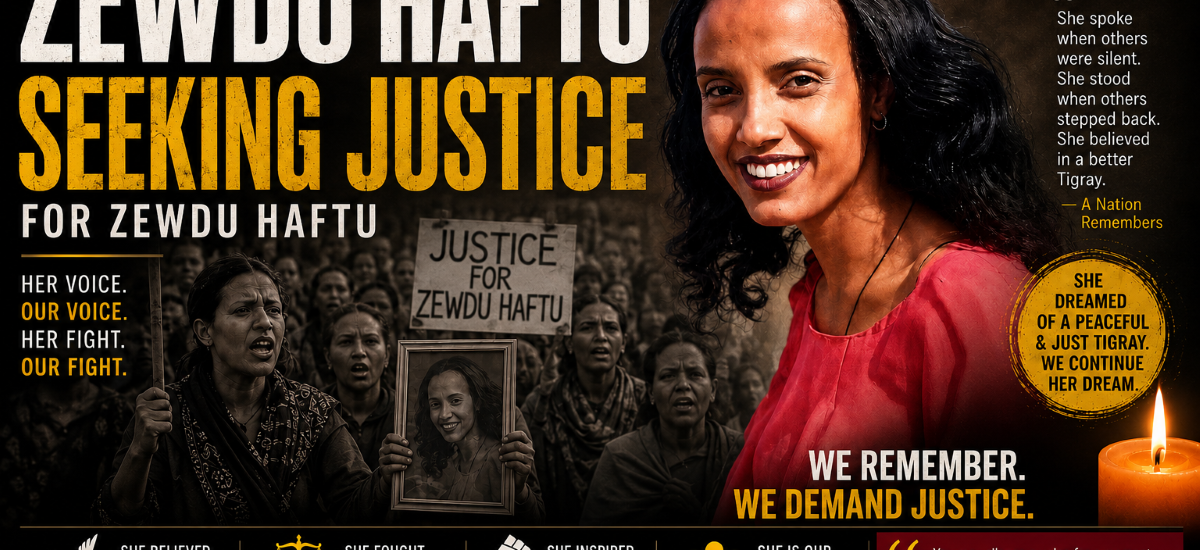
Zewdu Haftu was a 32-year-old woman and resident of Mekelle, Tigray.
On 13/12/2015 Ethiopian Calendar, during the Ashenda season, Zewdu was struck by a vehicle on a public road in Adi Haki Sub-City, around Desta Hotel in Mekelle, and lost her life.
Her death was a devastating loss to her family and loved ones. It also raised serious questions about the circumstances surrounding her death and whether those responsible would ultimately be held accountable.
Following the incident, individuals suspected of involvement in her death were taken into custody, and the case proceeded through the judicial system.
According to information available to TMRRA and an official statement issued by the Communication Directorate of the Tigray Regional State Supreme Court, the case passed through several stages of judicial proceedings.
At the initial stage, the Mekelle First Instance Court, after considering testimonial and documentary evidence presented before it, found the accused criminally responsible for Zewdu’s death and sentenced them to life imprisonment at a hearing held on 4/12/2017 Ethiopian Calendar.
The accused appealed.
What happened afterwards has left important questions that deserve clear and transparent answers.
2.From Conviction to Acquittal
According to the official statement of the Tigray Regional State Supreme Court, the case was subsequently brought before the criminal appellate proceedings of the Supreme Court.
The appellate court initially upheld the judgment of the Mekelle court, finding no error in the decision.
The accused then pursued a further appeal through the cassation process.
The cassation bench of the Tigray Supreme Court identified an issue that required further examination. It therefore overturned the previous decision on that basis and returned the case to the Mekelle First Instance Court for reconsideration of the identified issue.
The Mekelle court subsequently reconsidered the case. The parties were given an opportunity to present their arguments again, relevant evidence was considered, and witnesses were reheard.
According to the official statement, following this renewed examination, the court decided at its hearing on 29/11/2018 Ethiopian Calendar to acquit and release the accused.
TMRRA recognizes the importance of judicial independence, due process and the legal rights of every accused person.
However, the final outcome has left profound questions for Zewdu’s family and for members of the public seeking justice.
3.The Questions That Cannot Be Ignored
The central issue is not whether a court has the legal authority to acquit an accused person.
It does.
Nor does TMRRA seek to prejudge any individual or interfere with the independence of the judiciary.
The concern is whether the entire process leading to the final outcome was sufficiently transparent, thorough, evidence-based and consistent with the requirements of justice and the rule of law.
Zewdu lost her life during the daytime, on a public road, in an area where people were present and where significant public movement took place.
This raises a fundamental question:
How can a woman lose her life in a public place, yet after years of investigation and judicial proceedings, serious questions about responsibility for her death remain unresolved?
If those initially convicted were ultimately acquitted, then the public deserves to understand, within the limits of the law:
- What evidence formed the basis of the initial conviction?
- What specific issue later required the judgment to be reconsidered?
- What additional evidence or information was required?
- Was that evidence properly obtained and presented?
- Why did the subsequent examination result in acquittal?
- What happened to the investigation into the actual circumstances of Zewdu’s death?
- If the individuals initially convicted were ultimately found not criminally responsible, was the investigation continued to identify those actually responsible?
- What measures were taken to ensure that every reasonable line of inquiry was pursued?
These are not questions of revenge.
They are questions of truth, justice, accountability and public confidence in the rule of law.
4.TMRRA Does Not Prejudge Anyone
TMRRA wishes to make its position clear.
We do not seek to convict any individual through a public statement.
We do not seek to replace the authority of the courts.
We respect the legal rights of accused persons, including the right to due process, a fair hearing, legal representation and appeal.
At the same time, judicial independence does not mean freedom from transparency or accountability.
An independent judiciary must operate within the law.
And when a judicial outcome raises legitimate questions, those questions should be addressed through lawful, transparent and accountable mechanisms.
For TMRRA, justice requires a balance:
The rights of the accused must be protected.
The rights of victims must also be protected.
The independence of the judiciary must be respected.
The public’s right to confidence in justice must not be ignored.
5.Justice Must Also Speak for the Victim
Zewdu Haftu is no longer here to speak for herself.
Her family cannot bring her back.
But the justice system can ensure that her death is not forgotten and that every legitimate question surrounding her death is addressed through the law.
The loss of one woman’s life is not merely a private tragedy.
- It concerns the safety of women and girls.
- It concerns the protection of citizens.
- It concerns the credibility of public institutions.
- And it concerns the confidence of society in the justice system.
- Justice must not end with a court file.
- Justice must also seek the truth.
6.Three Years Later, Accountability Still Matters
The passage of time makes a complete and credible investigation even more important.
A case that remains unresolved for years risks losing evidence, weakening witnesses’ recollections and deepening the suffering of the victim’s family.
The appropriate response should not be to allow the case to disappear from public attention.
Instead, the relevant institutions should continue to ask:
Was the investigation complete?
Was every reasonable line of inquiry pursued?
Was all available evidence properly examined?
Were alternative explanations and possible suspects investigated?
And most importantly:
If the individuals initially convicted were ultimately acquitted, what steps were taken to establish who was actually responsible for Zewdu Haftu’s death?
These questions deserve lawful answers.
7.TMRRA Calls for Transparency and Accountability
In light of these concerns, the Tigray Mothers Relief and Rehabilitation Association (TMRRA) respectfully calls upon the relevant institutions to provide clear, lawful and transparent responses.
1. Tigray Bureau of Peace and Security
We call upon the Bureau to clarify, within its legal mandate, matters concerning the security and accountability dimensions surrounding this case.
2. Tigray Regional Police Commission
We call upon the Police Commission to clarify, to the extent permitted by law:
- The investigative steps taken following Zewdu’s death;
- The evidence presented during the judicial process;
- Any additional evidence or information requested during the proceedings;
- The steps taken to obtain and present such information;
- Whether further investigation was conducted following the acquittal; and
- What measures are being taken to establish the circumstances and responsibility for Zewdu’s death.
3. Tigray Justice Bureau
We call upon the Justice Bureau to provide, within the limits permitted by law, a clear explanation of the legal procedures followed and the relevant legal basis for the decisions taken throughout the case.
4. Tigray Bureau of Women and Social Affairs
We call upon the Bureau to stand firmly for the dignity, safety and rights of women in Tigray and to raise the concerns surrounding Zewdu Haftu’s case with the relevant justice and law-enforcement institutions.
5. Relevant Judicial and Accountability Institutions
We call upon the competent institutions to ensure that legitimate concerns surrounding the investigation and judicial process can be examined through appropriate, independent and lawful mechanisms.
If any procedural violation, institutional failure or improper interference is established through a lawful process, those responsible should be held accountable in accordance with the law.
8.This Is Bigger Than One Case
The case of Zewdu Haftu is not only about one woman.
- It is about the confidence of citizens in justice.
- It is about the safety of women and girls.
- It is about institutional accountability.
- It is about the rule of law.
- And it is about whether families who lose their loved ones can trust public institutions to pursue truth and justice without fear, favour or improper influence.
TMRRA believes that accountability should never be understood as an attack on institutions.
- Accountability makes institutions stronger.
- Transparency does not weaken justice.
- Transparency strengthens public confidence in justice.
- Judicial independence does not eliminate the need for lawful accountability.
- Strong institutions are institutions that can withstand legitimate questions and provide lawful answers.
9.We Call for Justice, Not Revenge
TMRRA does not call for retaliation.
- We do not call for punishment outside the law.
- We do not call for the public condemnation of individuals without due process.
We call for something more fundamental:
- Truth.
- Due Process.
- Transparency.
- Accountability.
- Justice.
The death of Zewdu Haftu should not become another unresolved chapter in the history of violence and insecurity affecting women in Tigray.
- Her family deserves answers.
- The public deserves confidence in the justice process.
- And every woman in Tigray deserves to know that her life matters and that institutions are prepared to investigate violence against women and pursue accountability through the law.
10. Justice for Zewdu Haftu
Accountability for All.
Dignity, Safety and Justice for All Women of Tigray.
Tigray Mothers Relief and Rehabilitation Association (TMRRA)
From Recovery to Sovereignty: Restoring Dignity, Health, Protection, and Economic Independence for Tigray’s Women and Communities.y and Justice for All Women of Tigray.
Tigray Mothers Relief and Rehabilitation Association (TMRRA)
From Recovery to Sovereignty: Restoring Dignity, Health, Protection, and Economic Independence for Tigray’s Women and Communities.