
When Peace Remains Only on Paper
When Peace Remains Only on Paper
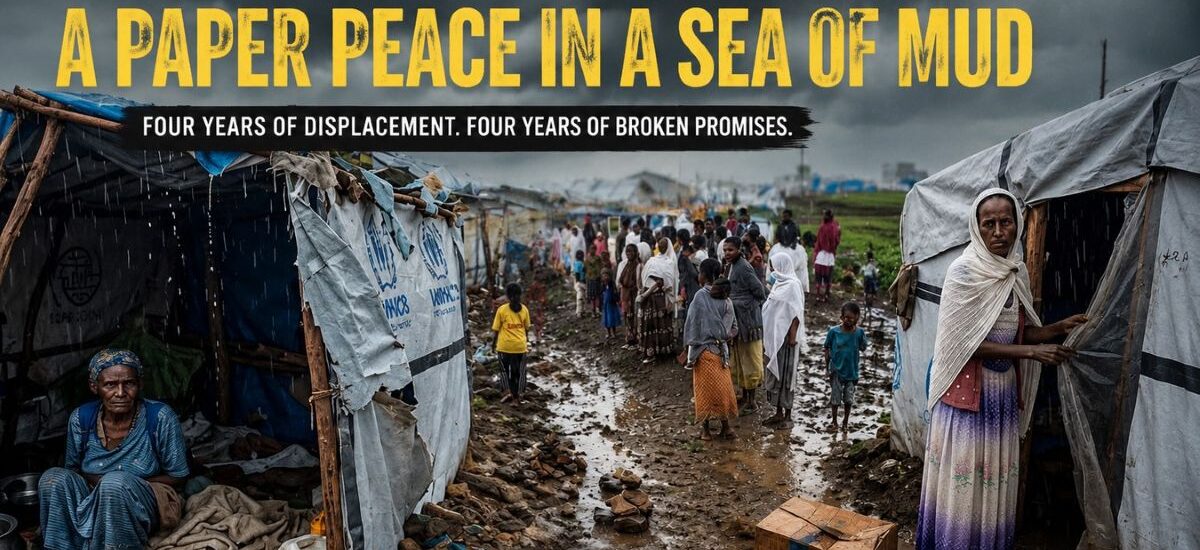
On November 2, 2020, the lives of millions of people in Tigray were violently upended. For the women captured in this photograph, that day did not simply mark the beginning of a war. It marked the beginning of a life suspended between displacement, uncertainty, loss, and survival.
Two years later, on November 2, 2022, the Pretoria Agreement was signed, raising hopes that the guns would fall silent and that displaced families would finally begin the journey home.
The world called it peace.
But what does peace mean to a mother standing ankle-deep in mud, sheltering beneath a torn sheet of plastic?
What does peace mean when a temporary camp becomes a permanent home?
And what does peace mean when families who lost their homes years ago are still waiting for safety, dignity, and the opportunity to rebuild their lives?
For thousands of displaced people in and around Mekelle, these questions remain painfully unanswered.
Four Years Beneath a Shredded Tarp
Look closely at the photograph.
There is no battlefield here. No gunfire. No military convoy.
There are simply women standing in the rain.
Yet this may be one of the clearest images of what a prolonged humanitarian crisis looks like.
For years, displaced families have lived in fragile shelters made from plastic sheets and whatever materials they can find. What was meant to be temporary has become an exhausting and uncertain existence with no clear end.
When the sun burns, the shelters become unbearable.
When the wind arrives, the plastic offers little protection.
And when the rain comes, the ground beneath their feet becomes mud.
Water enters their shelters. Clothes become soaked. Bedding and household belongings are damaged. Children struggle to remain warm and dry.
For people who have already lost homes, livelihoods, possessions, and years of their lives, even the most basic necessities—safe shelter, food, clean water, healthcare, education, and security—can remain uncertain.
But the mud is only one part of the story.
The Other Wounds of Displacement
For many women and girls, displacement was not simply a journey away from their homes. It was a journey through fear, violence, and profound uncertainty.
During the conflict and displacement, women and girls were exposed to serious risks of sexual and gender-based violence. Some survivors of sexual violence are themselves living in displacement sites, carrying physical injuries, psychological trauma, stigma, and memories that cannot simply disappear when the fighting stops.
Imagine surviving sexual violence and then being forced to continue living in an overcrowded and insecure displacement environment.
Imagine having no safe private space, limited access to healthcare and psychosocial support, and little certainty about what tomorrow will bring.
For survivors, displacement can mean that the place where they were supposed to find safety becomes another environment of vulnerability.
Their suffering did not end when the guns became quieter.
For some, it became less visible.
Children Lost Along the Way
War and displacement also tear families apart.
During the years of conflict and forced movement, children became separated from parents, relatives, and caregivers. Some fled across borders, including into Sudan. Some children have never been reunited with their families. For others, their whereabouts remain unknown.
Some families have lost children to violence. Others have seen loved ones killed or injured. Many have experienced harassment, abuse, exploitation, or the constant fear of losing those they love.
For a parent, not knowing where a child is may be a wound without closure.
For a child, growing up without knowing whether a parent is alive, where home is, or whether the family will ever be reunited can leave consequences that last for years.
Displacement does not only move people from one place to another.
It can fracture families, identities, childhoods, and futures.
The Distance Between Pretoria and the Camp
The Pretoria Agreement created an important opportunity to end the devastating conflict and establish a pathway toward recovery.
But an agreement signed in a conference room becomes meaningful only when its promises are felt in people’s homes and communities.
For displaced families, the real test of peace is not the ceremony.
- It is whether they can return safely.
- It is whether their homes can be rebuilt.
- It is whether essential services can be restored.
- It is whether children can return to school and be reunited with their families.
- It is whether survivors of violence can access medical care, psychosocial support, protection, and justice.
- It is whether mothers can rebuild livelihoods without depending indefinitely on emergency assistance.
And, above all, it is whether people who have endured years of displacement can once again live with dignity.
For many families, that transformation remains painfully incomplete.
A ceasefire can stop bullets. Peace must also restore lives.
When Emergency Assistance Is Not Enough
Humanitarian assistance remains essential. But for many displaced families, even basic emergency support remains limited compared with the scale and duration of their needs.
Food assistance, shelter support, healthcare, clean water, sanitation, protection services, psychosocial support, and other forms of humanitarian assistance are often insufficient to meet the realities of prolonged displacement.
Families cannot rebuild their lives through food distributions alone.
A mother cannot recover from trauma simply because she receives a food ration.
A child cannot recover lost years of education simply because an emergency shelter has been provided.
A survivor of sexual violence cannot heal without access to appropriate medical, psychosocial, protection, and referral services.
And a family separated by war cannot rebuild its future without efforts to trace, reunify, and protect its members.
Emergency assistance is a lifeline.
But a lifeline is not the same thing as a lasting solution.
The Hidden Emergency After the Headlines Fade
The world often pays attention to a crisis when the bombs are falling.
But what happens after the cameras leave?
Humanitarian emergencies do not disappear simply because a peace agreement has been signed.
Displacement can continue.
Poverty can deepen.
Trauma can remain invisible.
Children can lose years of education.
Families can remain separated.
Survivors of sexual violence can continue living with stigma and untreated trauma.
Women can carry the burden of caring for their families while living without adequate shelter, healthcare, or income.
Communities can remain trapped between the memory of what they lost and the uncertainty of what comes next.
This is the hidden emergency after the headlines fade.
It is quieter than war, but it can be devastating.
What Peace Must Deliver
If peace is to become real for displaced people, it must go beyond the absence of active fighting.
- Peace must mean safe and dignified return where return is possible.
- It must mean adequate shelter for those who cannot yet return.
- It must mean food security and access to clean water.
- It must mean healthcare and psychosocial support.
- It must mean protection and specialized services for survivors of sexual and gender-based violence.
- It must mean tracing and reunification of separated children and families.
- It must mean education for children who have already lost precious years.
- It must mean restored livelihoods and economic opportunities for women and families.
- It must mean accountability, dignity, and the right to rebuild a life.
Peace should be measured not only by the absence of gunfire, but by the presence of safety, dignity, opportunity, and hope.
A Direct Appeal to the International Community
To the United Nations, UNHCR, WFP, ICRC, international humanitarian agencies, human rights organizations, donors, and governments:
- Please look beyond the headlines.
- Look at the photograph.
- Look at the women standing in the rain.
- Ask how a family can be expected to rebuild its life after years of displacement while living beneath a torn plastic sheet.
- Ask what happens to a survivor of sexual violence who is still living in displacement without adequate support.
- Ask what happens to a child who became separated from their family during war.
- Ask what happens to the families who still do not know where their loved ones are.
- Ask why temporary shelters have remained temporary for so long.
- And ask what concrete steps are being taken to turn the promises of peace into meaningful, lasting change.
The people who endured the war must not be forgotten simply because the international spotlight has moved elsewhere.
To Humanitarian Agencies
Emergency assistance remains essential, but prolonged displacement requires more than repeated short-term interventions.
- Families need safe and dignified shelter, reliable food and water, healthcare, education, livelihoods, psychosocial support, protection, and a realistic pathway toward durable solutions.
- Survivors of sexual and gender-based violence need confidential, survivor-centered services and appropriate medical, psychosocial, protection, and referral support.
- Separated children and families need continued tracing, reunification, and protection.
- Humanitarian assistance should protect people today while helping create the conditions that allow them to rebuild tomorrow.
Emergency relief must not become a substitute for lasting solutions.
To Human Rights Organizations
Human dignity does not expire when a conflict ends.
The international community must continue documenting the conditions faced by displaced populations, amplifying their voices, monitoring commitments made to protect civilians, and advocating for durable solutions.
- The experiences of survivors of sexual violence must not disappear from public attention.
- The disappearance or separation of children and family members must not become an invisible consequence of war.
- The suffering of displaced people must not become invisible simply because the war is no longer dominating international headlines.
- Silence does not mean recovery.
- And the absence of headlines does not mean the absence of suffering.
To the Global Community
Do not allow the word “peace” to become a curtain hiding continuing suffering.
- Peace must be visible.
- It must be measurable.
- It must reach the people who need it most.
- And it must include those whose suffering has become less visible but no less real.
From Mud to Dignity
The women in this photograph are not asking the world for sympathy alone.
- They are asking for dignity.
- They are asking for the opportunity to return home safely.
- They are asking for their children to grow up without displacement becoming their childhood.
- They are asking for separated families to be reunited.
- They are asking for survivors of violence to receive care without stigma.
- They are asking for the means to work, rebuild, and stand on their own feet.
- They are asking the world to remember that behind every statistic is a human being—with a name, a family, a history, and a future.
The rain will eventually stop.
But the deeper question remains:
Will the suffering stop with it?
The Pretoria Promise Must Reach the People
The Pretoria Agreement represented hope.
That hope must not remain trapped in diplomatic language.
For displaced families, peace cannot be something remembered from a signing ceremony. It must become something they can touch, see, and experience in their daily lives.
- A rebuilt home.
- A safe community.
- A functioning school.
- A restored livelihood.
- A reunited family.
- A survivor receiving the care and protection she needs.
- A child knowing where home is.
- A mother who no longer fears the next rain.
That is what peace should look like.
The war may have changed form, but the humanitarian responsibility remains.
The people of Tigray deserve more than a paper promise. They deserve a peace that reaches the mud, the shelters, the mothers, the survivors, and the children.
We will continue to speak—not because these stories are easy to tell, but because silence would make the suffering easier to ignore.
The world must not look away.
The Pretoria promise must become a lived reality.